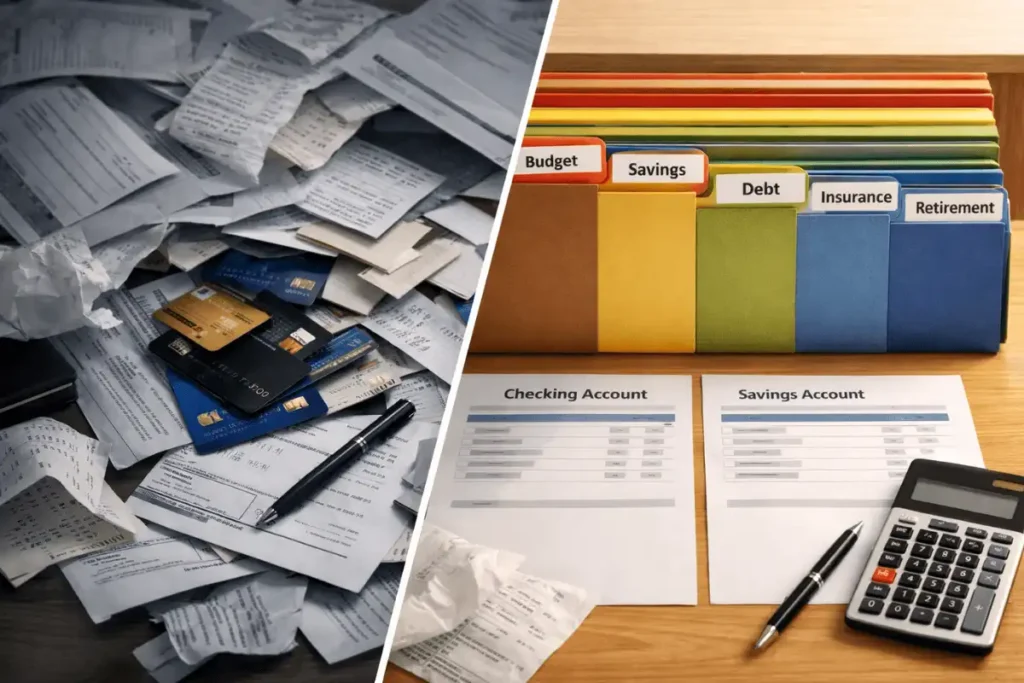

Paying off debt doesn’t have to feel like punishment or spark a budget meltdown. With smart debt management, you can chip away at balances while protecting groceries, rent, and a little fun money. The aim isn’t austerity—it’s sustainable progress that fits real life.
For a step-by-step foundation that ties debt payoff to savings, income, and goals, explore our complete guide: Personal Finance Guide.
Table of Contents
Smart debt management: your plan at a glance
Smart debt management keeps your essentials safe while you systematically lower interest and balances. Here’s the practical order that works:
- Protect essentials first (housing, utilities, food, transportation, insurance).
- Automate every minimum payment to avoid late fees.
- Choose one “priority” debt to attack.
- Make small, frequent extra payments (even $10–$50) when possible.
- Reduce interest wherever you can.
- Keep a small buffer so surprises don’t send you backward.
Why this order? Because consistency beats intensity. Going “all in” can backfire when a flat tire or medical copay pushes you to swipe the card again. Smart debt management builds steady momentum without inviting relapse.
Real-world example: Maya, a freelance designer, owed $6,800 across three cards at 22–28% APR. She automated minimums, picked the highest-rate card as her priority, and called each lender for a rate review. Two agreed to temporary reductions. She set a weekly $25 transfer to her priority card and added a mid-cycle payment every month to lower interest. In 10 months, she cleared the first two cards—without canceling date night or skipping family trips.
Map your numbers (gently) so your plan sticks
No shame—just data. Block 45 minutes. You’re creating clarity, not perfection.
1) Audit the last 60–90 days
- Sort transactions by category: housing, utilities, groceries, transportation, insurance, debt, and discretionary.
- Pick 2–3 categories to trim by 10–20% (not to zero). Look for subscriptions you don’t use, delivery/app fees, and impulse buys.
2) List every debt
- For each: balance, APR, minimum payment, due date, fixed or variable rate.
- Note promotional periods (e.g., 0% transfers) with their end dates.
3) Build a right-sized budget
- Fund essentials first. If money’s tight, assign every dollar a job.
- Automate minimums for all debts.
- Choose a realistic extra amount (even $40–$100/month) to send to your priority debt.
4) Create a micro-buffer
- Keep $300–$500 in a separate savings pocket. This prevents small emergencies from becoming new debt.
Use tools you’ll actually maintain—notes app, spreadsheet, or a simple budget app. Want a better-system view? Visit the Top 10 Best Personal Finance Apps for Americans
Pick the payoff path that fits you (not the internet)
The best strategy is the one you’ll stick with. Here’s a quick comparison:
| Method | Best For | Pros | Watch-outs |
|---|---|---|---|
| Avalanche (highest APR first) | Optimizers who want math savings | Lowest total interest; often fastest | Wins can feel slow if the first balance is large |
| Snowball (smallest balance first) | Motivation-seekers who like quick wins | Builds momentum; simplifies quickly | May cost a bit more in interest |
| Hybrid (balance + APR) | Most people | Balances speed and savings | Requires light tracking |
| Consolidation / 0% transfer | Good credit; high APRs | Lower rate; one payment | Fees; promo deadlines; re-spending risk |
Helpful notes:
- Avalanche usually saves the most money. If you love clear math wins, start there.
- Snowball’s quick wins are powerful if you’ve struggled with consistency.
- A hybrid could be: Clear any balance under $1,000 first, then switch to highest APR.
- Consolidation can help if the total cost (fees + interest) truly drops—not just the monthly payment.
If your credit is solid, a 0% balance transfer can be a powerful tool. Map a repayment plan to clear the transfer before the promo ends, and avoid new purchases on that card. If your score isn’t there yet, call your existing lenders to request a hardship rate or a temporary lower minimum. Many will work with you—especially if you’ve paid on time.
For current rate trends, see the Federal Reserve’s Consumer Credit (G.19) release.
Make progress without crushing your budget
These low-friction tactics quietly add up.
1) Automate the essentials
- Auto-pay the minimum on every debt to dodge late fees.
- Schedule your extra payment the day after payday.
2) Time your payments to reduce interest
- Make one payment on the due date and another mid-cycle. More frequent payments can reduce the average daily balance, lowering interest—without paying more overall.
3) Negotiate your rates (10-minute calls)
- Ask for a lower APR, a hardship rate, or a fee waiver.
- Script: “I’ve been a loyal customer. I’m working on repayment and would like to lower my APR to [X]% or reduce fees. What options do you offer?”
- If they say no, ask for a supervisor or try again another day. Persistence helps.
4) Use micro-sprints, not austerity
- Try a 7-day no-spend on non-essentials and send the savings to your priority debt.
- Create a “cashback jar”: every rebate or $5–$20 surprise goes to debt the same day.
5) Turn raises or side gigs into leverage
- Earmark a fixed percentage (say 50–70%) of new income for debt; keep the rest for lifestyle and savings. Progress without resentment.
6) Right-size variable expenses
- Trim dining out, groceries, and entertainment by 10–20% instead of slashing to zero. Workable beats perfect.
7) Use windfalls wisely
- Tax refund or bonus? Send 60–80% to debt, 10–20% to your buffer, and 10–20% to something joyful. Progress + joy = sustainability.
Mini-case: After tracking expenses, Maya canceled two unused subscriptions ($28/month), switched car insurance to a cheaper provider ($34/month saved), and batch-cooked twice a week to cut delivery fees ($60/month saved). That’s $122/month—plus her weekly $25 transfer—roughly $222/month in extra payments. Over a year at ~24% APR, that’s hundreds in interest avoided and months shaved off.
When cash is tight: protect essentials and find relief
If rent, food, and utilities are fighting with debt minimums, it’s time to seek support.
1) Call lenders early
- Ask about hardship programs: reduced APRs, interest-only periods, or extended payment plans.
- Document everything: representative name, date, and terms.
2) Consider nonprofit credit counseling
- Certified counselors can help you build a plan or enroll in a Debt Management Plan (DMP) that may reduce rates and consolidate payments.
- Start with the National Foundation for Credit Counseling: NFCC
- You can also search approved agencies via the U.S. Department of Justice: DOJ Credit Counseling Search
3) Weigh settlement carefully
- Debt settlement firms may ask you to stop paying, which can harm your credit and trigger fees. Research thoroughly before signing.
- The Consumer Financial Protection Bureau explains the risks: CFPB on Debt Settlement
4) Bankruptcy is a last-resort tool—not a failure
- If debts are truly unpayable, a bankruptcy attorney can explain Chapters 7 and 13. For some, it’s the reset that restores stability. Get a consultation to understand the tradeoffs and timelines.
Bottom line: essentials come first. A safe home, food, utilities, and healthcare are non-negotiable. Smart debt management supports your life while you tackle balances.
Pro tips to boost savings and speed
These small upgrades make your plan more powerful:
- Align due dates with your pay schedule to reduce cash-flow crunches. Most lenders will adjust upon request.
- Remove authorized users you’re no longer supporting (and close old store cards if they tempt you), but be mindful of potential score changes.
- If you carry variable-rate debt, watch for rate changes and revisit your priority order quarterly.
- Track your credit utilization (balances ÷ limits). Reducing utilization below 30%—and even 10%—can support your credit score, which may unlock lower rates later.
Stay motivated and relapse-proof your plan
Consistency is the compounding effect you control. Keep it engaging:
- Use a visual tracker: color a thermometer or progress bar after each payment.
- Set milestone rewards: every $500 paid off earns a modest treat (movie night, new book, coffee date).
- Add friction to spending: remove stored cards from browsers, set a 24-hour rule for non-essentials, and unsubscribe from promo emails.
- Share your goal with one supportive friend for built-in accountability.
- Schedule monthly money check-ins: review balances, celebrate wins, and tweak the plan.
Build a “future payment” habit: the day a debt disappears, redirect that exact payment to your next priority. Your lifestyle doesn’t feel a cut, but your payoff speed accelerates dramatically.
Finally, clarify your “debt-free why.” Is it the calm of a funded emergency cushion? The freedom to change jobs? Paying for a family trip in cash? Keep that purpose visible. Motivation is a system, not a mood.
FAQs: quick answers to common questions
- Should I save an emergency fund before paying extra to debt? Aim for a micro-buffer of $300–$500 first, then split focus: maintain the buffer while directing extra to your priority debt.
- Avalanche or snowball—what’s better? Avalanche costs less in interest; snowball can be easier to stick with. Choose the one that keeps you moving.
- Are balance transfers worth it? If fees are reasonable and you can clear the balance within the promo window, yes. Freeze spending on that card to prevent backsliding.
- How often should I revisit my plan? Monthly is ideal. Update balances, confirm rates, and adjust your priority order if needed.
Conclusion: Your budget and your payoff can be friends
Smart debt management is about protecting essentials, choosing a payoff path that fits your brain, and steadily shaving interest with simple, repeatable moves. Automate minimums, stack extra payments on one priority debt, and time payments to lower interest. When helpful, negotiate rates, consider a 0% transfer, or work with a reputable counselor. Most importantly, make your plan livable.
Start today with one small action: list your debts, automate minimums, and schedule your first extra payment—even if it’s $20. Momentum beats maximum every time. For a bigger-picture strategy that aligns debt payoff with saving and investing, revisit the Personal Finance Guide.