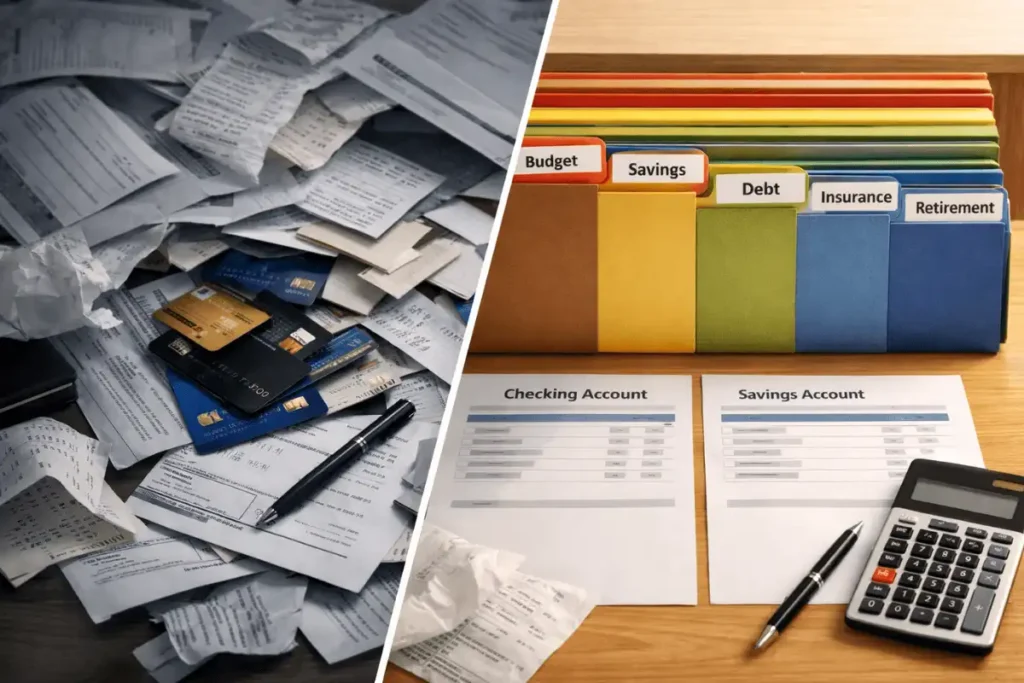
Most money leaks aren’t dramatic. They’re the quiet, everyday personal finance mistakes to avoid—an autopay here, an unnecessary fee there—that quietly drain thousands a year. The good news: most are fixable, and quicker than you think. In this guide, you’ll learn which slip-ups cost the most, what they actually look like in real life, and the simple, proven steps to stop the leaks for good.
If you’re building from scratch or want a solid reset, pair this with our step-by-step personal finance guide to get your foundation right before you optimize the details.
Table of Contents
Personal Finance Mistakes to Avoid at a Glance
Before we dive deep, here’s the mindset: money wins come from systems, not willpower. The personal finance mistakes to avoid most often show up in four places: thin cash buffers, high-interest debt, silent fees, and lifestyle creep. Fix those, and you’ll feel momentum in weeks—not months.
1) Thin Cash Buffers: No Emergency Fund, Costly Overdrafts
An emergency fund is a financial shock absorber. Yet the Federal Reserve’s surveys show many Americans would struggle with a modest unexpected bill. Without a buffer, surprise expenses trigger overdrafts or expensive credit card debt.
What it really costs:
- Overdraft/NSF fees often run $25–$35 per incident. If three automatic debits hit back-to-back, you could burn $100+ in days.
- Put a $600 car repair on a 24% APR credit card and only pay minimums? You can add hundreds in interest across the year.
Fast, realistic fixes:
- Start a mini buffer: Automate $25–$50 per paycheck into a high-yield savings account (many HYSAs have offered competitive APYs in recent years). Treat it like rent—non-negotiable.
- Use two checking accounts: One for bills (fund it for the whole month on payday) and one for daily spending. This cuts surprise overdrafts.
- Turn on low-balance alerts; ask your bank about grace periods. If possible, opt out of debit card overdraft “protection.”
- Direct windfalls (tax refunds, bonuses, cash gifts) to hit your first $1,000, then build toward 3–6 months of expenses.
Why this works: Even a $500 cushion reduces overdraft risk dramatically. It also prevents “small emergencies” from becoming credit card debt that lingers.
2) High-Interest Debt and Credit Missteps
Credit card APRs have hovered above 20% in recent years—brutal math for anyone paying minimums. This is one of the biggest personal finance mistakes to avoid because it quietly taxes your future income.
The price of waiting:
- Example: $5,000 at 24% APR with $150/month payments takes roughly 44 months and nearly $1,600 in interest—without adding new charges.
- A single 30-day late payment can dent your credit score, which can mean pricier auto loans or a higher mortgage rate later.
Smart, proven payoff strategies:
- Pick a method you’ll stick with: Avalanche (highest APR first) saves the most interest; Snowball (smallest balance first) builds fast wins. Both work.
- Negotiate APRs: Call your issuer. A 3–5 point reduction can save hundreds annually—especially if you’re paying more than minimums.
- Consider a 0% balance transfer with a structured plan. Watch the transfer fee and end date; set calendar reminders 60 and 30 days before the promo ends.
- Automate on-time minimums. Then, make extra mid-cycle payments to your target card—this can lower reported utilization and potentially boost your score faster.
When to call in backup:
- If your debt-to-income ratio is high or you’re juggling payments, talk to a nonprofit counselor at the National Foundation for Credit Counseling (NFCC).
Protect your credit score:
- Pay at least the minimum on time, always.
- Keep utilization below 30%; below 10% is even better. You can lower utilization by paying before the statement closes.
- Don’t close old accounts without a plan—credit history length helps.
3) Leaving Free Money on the Table: Employer Benefits and Taxes
Few personal finance mistakes to avoid are as costly as ignoring employer matches or tax-advantaged accounts. These are “guaranteed returns” you shouldn’t pass up.
Employer match = instant ROI:
- If your employer matches 4% on a $60,000 salary, that’s $2,400 a year—free. Over 20 years at a 7% annualized return, that’s roughly $100,000+ added to your nest egg, simply for contributing up to the match.
Tax-advantaged accounts to leverage:
- Workplace plans (401(k)/403(b)) and IRAs: Traditional contributions may lower taxable income now; Roth contributions grow tax-free and can be powerful if you expect higher taxes later.
- Health Savings Account (HSA): For high-deductible health plans only. HSAs offer triple tax advantages—pre-tax contributions, tax-free growth, and tax-free qualified withdrawals.
- Flexible Spending Accounts (FSAs): Useful for health or dependent care expenses. Many plans have use-it-or-lose-it rules—set contributions conservatively and track deadlines.
Dial in your withholding:
- A big tax refund can mean you gave the government an interest-free loan. Use the IRS Tax Withholding Estimator to fine-tune your W-4 so you keep more per paycheck and automate savings to your goals.
Annual checklist:
- Increase retirement contributions by 1–2% each year or after raises.
- Confirm you’re capturing the full employer match.
- Review HSA/FSA during open enrollment.
- Re-run the withholding estimator after life changes (raise, marriage, new child, home purchase).
4) Silent Fee Drains: Banking, Investing, and Insurance
Fees are the termites of your wallet—small, hidden, destructive over time. Eliminating them is one of the smartest personal finance mistakes to avoid.
Banking fees you might be paying right now:
- Monthly maintenance ($5–$15), out-of-network ATM fees, and overdrafts add up fast. Many online banks offer no monthly fees and ATM reimbursements. A quick switch can save $150+ a year.
Investment fees that quietly shrink returns:
- A 1% advisory fee on $250,000 is $2,500 per year. Over 20 years, that’s the price of a car—gone. Most active funds underperform their benchmarks over time, according to the SPIVA U.S. Scorecard.
- Prefer low-cost index funds and ETFs where appropriate, and compare expense ratios (ERs). A difference between 0.80% and 0.05% ER is enormous over decades.
Insurance overspend (and under-insuring):
- Auto/home premiums vary widely across companies and states. Shopping and bundling can trim 10–25%. Raising deductibles (say, $500 to $1,000) can lower premiums—just be sure your emergency fund can cover the higher out-of-pocket.
- Don’t strip coverage to save a few dollars. Inadequate liability or skipping uninsured/underinsured motorist protection can cost far more after a claim.
Action plan, 30 minutes at a time:
- List recurring fees (banks, brokerages, apps). Cancel, renegotiate, or move to lower-cost alternatives.
- Move core investments to low-cost funds (when appropriate) and review annually.
- Shop insurance each year, especially after life events or vehicle/home changes.
5) Lifestyle Creep, Subscriptions, and Impulse Spending
As income rises, spending naturally follows. Without guardrails, though, it can erase your progress. One of the most underrated personal finance mistakes to avoid is ignoring the quiet growth in recurring costs.
Subscriptions: the stealth budget killer
- Consumers regularly underestimate what they spend on subscriptions. With dozens of services charging $5–$20, it’s easy to leak $100–$200 per month. A quick audit can recover serious cash.
Control the creep:
- Run a quarterly “subscription audit.” Download your last two statements, highlight monthly/annual charges, and cancel aggressively.
- Move discretionary apps to one card or a virtual card, so you can see them in one place—and freeze the card if needed.
- Ask for retention discounts or switch to annual if you truly use it.
Tame impulse spending:
- Use the 24-hour rule for non-essentials over a threshold (say $50–$100).
- Keep a wish list. If it still matters in 30 days, buy with intent.
- Shop with a list, check unit prices, and avoid “hunger shopping.”
Automate good behavior:
- When you get a raise, first bump savings/investments by 2–3%, then let lifestyle expand. This one habit protects your growing surplus.
The Real-World Costs and Fixes
| Money Mistake | Typical Annual Cost | Quick Fix |
|---|---|---|
| No emergency fund | $200–$600 in overdrafts/interest | Automate $25–$50 per paycheck to HYSA; target $1,000 then 3–6 months |
| High-interest credit card debt | $500–$1,500+ in interest | Use Avalanche/Snowball; negotiate APR; 0% transfer with a clear payoff plan |
| Skipping employer 401(k) match | $1,000–$3,000+ missed yearly | Contribute at least to the full match; auto-increase 1–2% annually |
| Investment/bank fees | $150–$2,500+ (balance-dependent) | Switch to low-cost funds; use no-fee accounts; review yearly |
A Simple 7-Day Action Plan
These are short, highly actionable steps. Do one each day and you’ll feel a real shift by the end of the week.
- Day 1: Check bank overdraft settings; set low-balance alerts. Open a HYSA and automate the first transfer.
- Day 2: List debts, APRs, and minimums. Choose Avalanche or Snowball. Autopay minimums to avoid late fees.
- Day 3: Call one card issuer and request a rate reduction or hardship program. Script: “I’ve been a loyal customer. Are there any lower-rate offers or programs available?”
- Day 4: Log into your 401(k)/403(b). Make sure you’re capturing the full match. Set a 1% auto-increase.
- Day 5: Review HSA/FSA eligibility. If eligible, schedule a monthly HSA transfer. Confirm plan fees.
- Day 6: Subscription audit. Cancel at least three you don’t use. Move remaining to one card.
- Day 7: Investment fee check. Review expense ratios and advisory fees. Move at least one holding to a lower-cost alternative.
Quick Wins Most People Overlook
- Mid-cycle credit card payment: Paying part of your balance before the statement closes can reduce reported utilization and may lift your credit score sooner.
- Insurance deductibles: If your emergency fund can handle it, nudging deductibles higher can cut premiums—then redirect those savings to your HYSA or IRA.
- Cash-back stacking (responsibly): Use one strong cash-back card and a reputable shopping portal for essentials—never carry a balance just to chase rewards.
- Price matching: Keep receipts and politely ask. Many retailers will match advertised prices.
- Direct deposit split: Route a percentage of every paycheck straight to savings. If it never hits checking, you won’t miss it.
Frequently Asked Questions
What’s the first personal finance mistake to fix if I’m overwhelmed?
- Start with overdraft prevention and a mini emergency fund. A small buffer stops the bleeding and gives you breathing room to tackle debt.
Should I invest before I’m debt-free?
- Capture your 401(k) employer match (it’s an instant return). Then prioritize high-interest debt payoff while making minimums on everything else. Once debt APRs are below likely long-term market returns, increasing investments becomes compelling.
How often should I revisit my plan?
- Seasonally works well—every 90 days. Re-check fees, subscriptions, and progress. Use your calendar so it actually happens.
Are online banks safe?
- Look for FDIC insurance for bank accounts or NCUA insurance for credit unions. Learn more about deposit protection at FDIC: Deposit Insurance.
Conclusion: Small Fixes, Big Compounding Wins
Most personal finance mistakes to avoid aren’t about intelligence—they’re about systems. Tighten a few screws (cash buffer, debt strategy, low fees, full employer match, and subscription control), and you can reclaim thousands each year. Start with one quick win today—set that emergency fund transfer or raise your 401(k) contribution by 1%. Then stack another win tomorrow. Your future self will be thrilled you did.
For more structure and checklists, see our comprehensive personal finance guide.