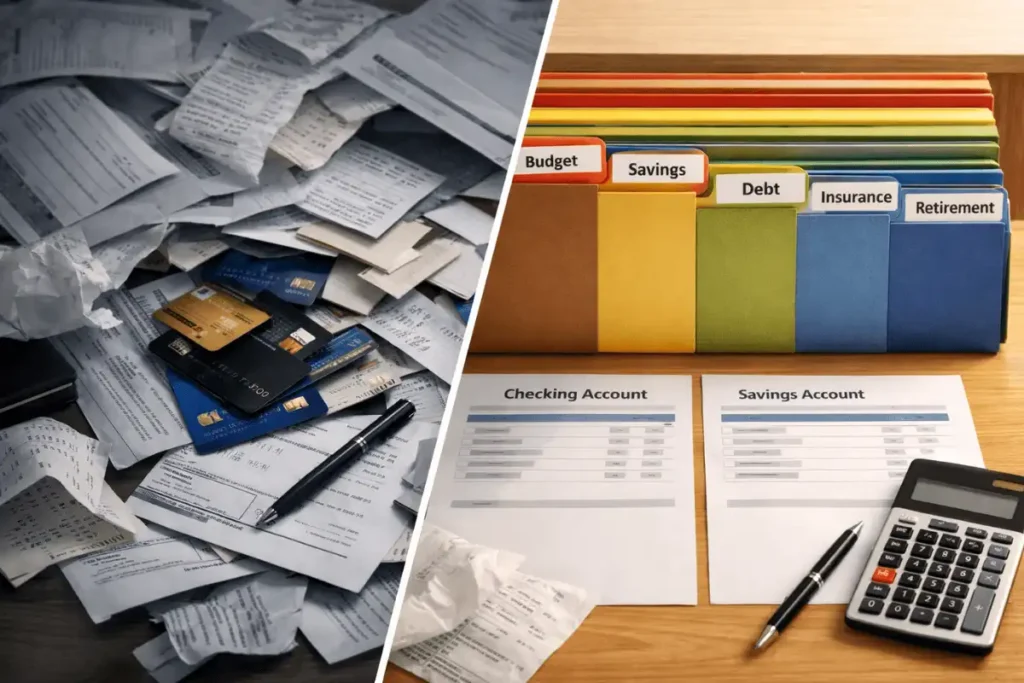

Inflation and interest rates sound like textbook terms—until they hit your wallet. Inflation and interest rates affect how far your paycheck goes, what you earn on savings, and what you pay to borrow. Once you understand how inflation and interest rates move together, you can make smarter decisions about saving, borrowing, and investing—without getting lost in jargon.
For a bigger-picture playbook on budgeting, saving, and investing fundamentals, explore our flagship resource: Personal Finance Guide.
Table of Contents
Inflation and Interest Rates: The Basics
Inflation is a general rise in prices over time; interest rates are the price of borrowing money. When inflation runs hot, central banks typically raise interest rates to cool the economy. When growth slows and inflation eases, they cut rates to encourage borrowing and spending. That push-and-pull explains why inflation and interest rates show up everywhere—from your grocery bill to your mortgage quote.
How we measure inflation:
- CPI (Consumer Price Index): Tracks a basket of everyday goods and services.
- PCE (Personal Consumption Expenditures): A broader measure the Federal Reserve emphasizes.
- Headline vs. core: Headline includes food and energy; core excludes them to smooth out volatility.
Why inflation happens:
- Demand-pull: Spending outpaces supply.
- Cost-push: Input costs (like energy or wages) rise, and businesses pass them on.
- Expectations: If households and businesses expect higher inflation, they adjust wages and prices—often making it a self-fulfilling loop.
Practical takeaway: Track prices you actually pay (groceries, rent, utilities), and keep an eye on CPI trends. Both inform your next money move.
How the Fed Sets the Tone
The Federal Reserve influences short‑term rates through its policy rate (the federal funds rate). Markets then translate expectations into Treasury yields, mortgage rates, and what banks pay on savings.
Key rates to watch:
- Federal funds rate: The Fed’s primary tool.
- Treasury yields: Market-based rates that ripple into mortgages and other loans.
- Savings and CD rates: What banks pay you for deposits, often lagging but responsive when rates swing.
What this means for you:
- Higher rates: Borrowing gets pricier (mortgages, auto loans, credit cards), but cash yields improve (savings, CDs, money market funds).
- Lower rates: Loans get cheaper, but your cash earns less—so you may need to invest more strategically.
A quick, real-world illustration: Suppose a $350,000 30-year fixed mortgage. At 3% interest, the principal and interest payment is about $1,476/month. At 7%, it jumps to roughly $2,329/month. Same house, radically different payment—because inflation and interest rates changed the math.
How Inflation and Interest Rates Touch Every Corner of Your Money
Inflation and interest rates don’t move in isolation—they shape day-to-day decisions you make.
Savings and Cash
- High inflation + low rates: Cash loses buying power fast.
- High inflation + high rates: Yields improve, but you still must compare your APY to inflation.
- Low inflation + low rates: Returns are modest; prioritize liquidity, safety, and low fees.
Actionable moves:
- Shop for high‑yield savings or money market funds, especially when rates rise.
- Consider laddered CDs or short‑term Treasuries in stable or falling rate environments.
- Confirm coverage: FDIC Deposit Insurance for banks and NCUA for credit unions.
Borrowing: Mortgages, Auto Loans, and Credit Cards
- In high-rate periods, new debt is expensive. Focus on paying down high‑APR balances first.
- If you have to borrow, compare offers aggressively and consider shorter terms.
- When rates decline, refinancing fixed loans can save thousands—if closing costs and your timeframe justify it.
Personal example: During the 2020 trough, I refinanced a fixed mortgage. The monthly payment fell sharply, and the total interest over the life of the loan dropped by tens of thousands. Inflation and interest rates shifted, and timing mattered.
Investing: Stocks, Bonds, and Real Assets
- Stocks: Rising rates can compress valuations, particularly for growth companies. Well‑run firms with pricing power often hold up better.
- Bonds: Rates up, bond prices down; rates down, bond prices up. Shorter duration helps manage rate risk.
- TIPS (Treasury Inflation‑Protected Securities): Adjust principal with inflation, providing a hedge. See market expectations at FRED: Inflation Expectations.
- Real assets: Real estate and commodities can provide diversification, but risks vary with leverage, liquidity, and cycles.
Your Paycheck and Career
Inflation and interest rates influence wage trends and hiring. In higher inflation, push for cost‑of‑living adjustments and document your impact. Strengthen your skills to improve your pricing power at work—your best inflation hedge is often a stronger, more resilient income.
A Practical Playbook for Different Environments
Use this to adapt quickly when inflation and interest rates change.
| Environment | Cash & Savings | Debt Strategy | Investing Tilt |
|---|---|---|---|
| High Inflation, Rising Rates | High‑yield savings; money markets; consider TIPS | Pay down variable‑rate/high‑APR debt | Short duration bonds; quality stocks with pricing power |
| High Inflation, Falling Rates | Lock CD rates before they drop | Evaluate refinancing fixed loans | Extend duration gradually; balanced equities |
| Low Inflation, Low Rates | Prioritize liquidity; avoid fee drag | Cheaper borrowing; optimize terms | Diversified equities; watch valuations |
| Low Inflation, Rising Rates | Shop bank/APY competition | Favor fixed over variable | Short/intermediate bonds; dividend growers |
A 10‑Minute Monthly Checkup
Make these quick checks a habit so inflation and interest rates never blindside you:
- Scan CPI headlines: Is inflation trending up or down?
- Glance at the yield curve: Are rates moving higher or lower across maturities?
- Compare your cash APY to inflation: If your yield lags badly, move to a better account.
- Reprice your debt: If rates fall meaningfully, run refinancing numbers and check fees.
- Sanity‑check your allocation: Ensure your bond duration matches the rate backdrop, and your equity mix still fits your risk tolerance.
Practical Moves You Can Make This Month
- Audit your cash: Note APY, fees, and coverage. If you earn a fraction of 1% while competitors pay 4%+, move—don’t wait.
- Rank your debts by APR: Attack the highest rate first (especially credit cards); automate extra payments.
- Review your 401(k)/IRA: Understand your bond duration and equity exposure; rebalance if drifted.
- Add inflation protection: Consider TIPS or I Bonds (mind annual purchase limits and holding rules via TreasuryDirect).
- Build or top up an emergency fund: 3–6 months is a solid target; volatile periods reward preparedness.
For a step‑by‑step foundation on budgeting, saving, and investing, start with our Personal Finance Guide.
Mistakes to Avoid
- Chasing yield without reading terms: Promotional rates can drop; withdrawal limits and fees matter.
- Extending bond duration right before a rate surge: Rising yields can hit long‑term bonds hard.
- Letting cash sit at near‑zero: Opportunity cost adds up quickly during high‑rate periods.
- Ignoring taxes and fees: A small fee can erase most of a yield advantage; use tax‑advantaged accounts when possible.
Real‑World Scenarios
Stories make the math tangible and show how inflation and interest rates shape outcomes.
1) First‑Time Homebuyer in a High‑Rate Market
Problem: Rates climbed from ~3% to 6–7%, crushing affordability.
What worked:
- Increased down payment while renting an extra year.
- Improved credit score to qualify for better pricing tiers.
- Bought a smaller starter home with rental potential to hedge risk.
- Watched for dips to refinance later.
Result: Avoided stretching, kept flexibility, and positioned for a future refi if inflation and interest rates ease.
2) Near‑Retiree Guarding Against Inflation
Problem: A fixed income lagged rising prices; cash yields improved but didn’t always beat inflation.
What worked:
- Built a “cash bucket” of 12–24 months of expenses in high‑yield accounts and money market funds.
- Laddered short‑term Treasuries and CDs to capture rising rates progressively.
- Added TIPS for explicit inflation protection.
- Kept a diversified equity sleeve for long‑term growth.
Result: Smoothed portfolio withdrawals, reduced sequence‑of‑returns risk, and protected purchasing power.
3) Small Business Owner Balancing Growth and Costs
Problem: Supplier costs rose, customers were price‑sensitive, and credit lines became costlier.
What worked:
- Negotiated multi‑year supplier contracts to stabilize input costs.
- Raised prices modestly while upgrading value (bundles, service tiers, loyalty perks).
- Replaced a variable‑rate line with a fixed‑rate term loan.
- Tightened working capital: quicker receivables, leaner inventory turns.
Result: Preserved margins and kept customers by pairing fair pricing with better service.
Step‑by‑Step Framework You Can Reuse
Let inflation and interest rates inform your plan, not dictate it.
1) Diagnose your environment
- Track CPI, the Fed’s stance, and Treasury yields monthly.
- Translate the macro to your personal picture: cash APYs, loan rates, and your portfolio mix.
2) Optimize your cash
- Move idle funds to competitive high‑yield savings or money market funds.
- Ladder CDs/Treasuries if you want visibility on returns and potential protection from falling rates.
3) Triage your debt
- Prioritize variable‑rate and high‑APR balances.
- If rates drop meaningfully, price out refinancing—include closing costs and break‑even time.
4) Adjust investments thoughtfully
- In rising‑rate environments, shorten bond duration to reduce rate sensitivity.
- Consider TIPS to hedge inflation.
- Keep diversified equities, emphasizing quality balance sheets and pricing power.
5) Protect your income
- Upgrade skills, negotiate raises, and explore side income if appropriate.
- Review insurance and keep an emergency fund—resilience beats prediction.
Conclusion
Inflation and interest rates aren’t abstract—they’re the forces shaping your daily money life. When you recognize how inflation and interest rates interact, you can optimize cash, manage debt smarter, and invest with confidence. Run the monthly checkup, shop for better yields, prioritize high‑APR debt, and right‑size your bond duration while staying diversified.
Want a complete, plain‑English roadmap? Start here: Personal Finance Guide. Then take one decisive step today—move your cash to a higher APY, line up your debts by APR, or rebalance your portfolio. Small, consistent moves add up to durable financial confidence.