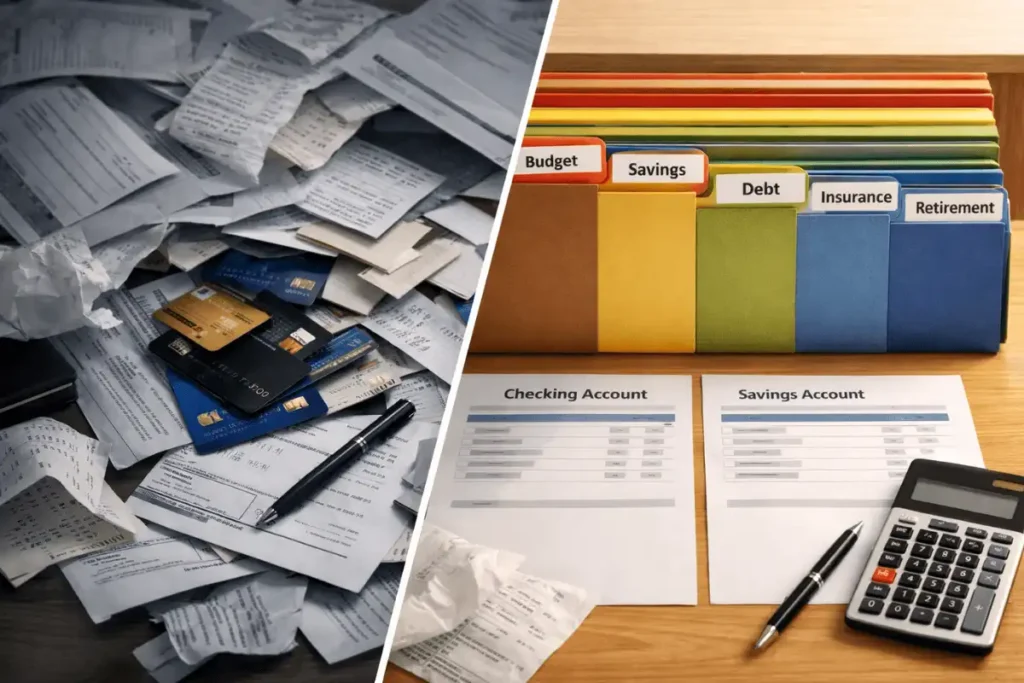
If your budget keeps collapsing by the 15th, take a breath—you’re not bad with money. Your plan just isn’t built for real life. A simple monthly budget can work even when income is messy and expenses pop up at the worst times. After years of overcomplicating, I switched to a simple monthly budget with a 10-minute weekly check-in and a few flexible rules. It’s been the most stress-free approach I’ve used.
For a deeper foundation on managing money across saving, debt payoff, and smart spending, see our Personal Finance Guide: Personal Finance Guide.
Table of Contents
What Makes a Budget Actually Work?
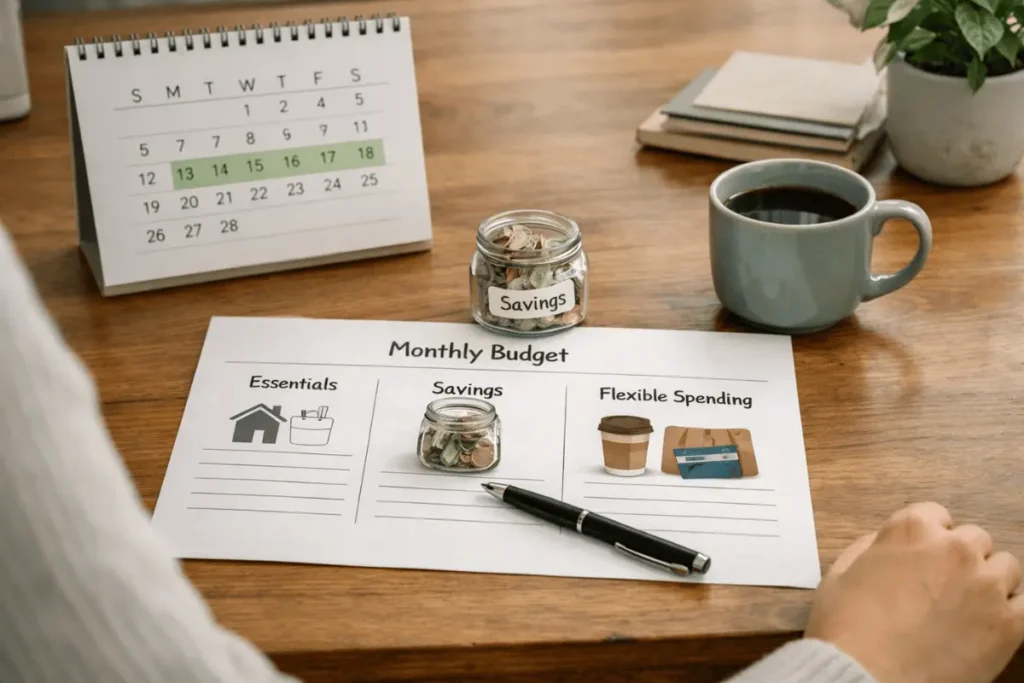
A simple monthly budget isn’t a rigid spreadsheet. It’s a living plan that helps you:
- See cash flow clearly—what’s coming in and going out
- Fund essentials and goals before optional spending
- Adjust quickly when life happens (because it will)
- Stay motivated with visible, weekly wins
At first, I tried tracking every penny. Exhausting. What finally worked was a handful of categories, a weekly pulse check, and a built-in buffer. The result: fewer surprises, less guilt, more control.
Simple Monthly Budget: Step-by-Step
You can set this up in under an hour. Then spend just 10 minutes each week to keep it on track.
Step 1: Start with real monthly income
Use take-home pay (what hits your bank after taxes and deductions). If your pay varies, average the last 3–6 months and set a conservative “baseline” income you know you can rely on.
- Unsure about your net pay? Try the IRS’s helpful tool: IRS Tax Withholding Estimator.
Step 2: Snapshot the last 30–60 days of spending
Skim transactions and group them into a few core categories:
- Housing (rent/mortgage)
- Utilities (electric, water, internet)
- Insurance & medical
- Debt payments
- Groceries
- Transportation (gas, transit, rideshare)
- Childcare & education
- Subscriptions
- Eating out & fun
- Savings & investments
Ballpark numbers are fine. The goal is clarity, not perfection.
Step 3: Choose a simple framework (and stick with it for 30 days)
| Framework | Best For | Quick Rule |
|---|---|---|
| 50/30/20 Rule | Beginners and stable income | 50% needs, 30% wants, 20% savings/debt |
| Zero-Based Budget | Goal chasers, overspenders | Every dollar gets a job; income minus expenses = 0 |
| Pay-Yourself-First | People focused on saving/investing | Automate savings first, spend the rest |
I like a hybrid: pay yourself first (savings and debt), then use 50/30/20 to prevent lifestyle creep.
Step 4: Set monthly targets you can actually hit
Example with $4,000 take-home pay:
- Needs (50%): $2,000
- Wants (30%): $1,200
- Savings/Debt (20%): $800
Assign rough targets within each bucket. Don’t forget annual or quarterly costs (insurance premiums, memberships). A simple monthly budget works best when irregular expenses are planned for.
Step 5: Open 3–5 sinking funds for “non-monthly” bills
Sinking funds are mini savings buckets for known-but-irregular costs. They stop “surprise” bills from wrecking your month.
Examples:
- Car maintenance: $50–$100/month
- Holidays & birthdays: $50/month
- Travel: $100/month
- Annual subscriptions: $20–$40/month
When my car registration hit, it used to blow everything up. After setting aside $10–$15 a month, it became a non-event.
Step 6: Pick your tracking method (and keep it simple)
- Spreadsheet (Google Sheets/Excel)
- Budgeting app. For more details, check out our article on Top 10 Best Personal Finance Apps for Americans (2025 Reviews & Comparison)
- Cash envelopes for tricky categories
- Calendar method: write weekly totals and due dates on a wall calendar
The “best” method is the one you’ll use consistently.
Step 7: Do a 10-minute weekly check-in
Set a recurring reminder. Each week:
- Reconcile transactions (categorized, not perfect)
- Compare your totals to targets
- Move money between categories if needed (permission to adjust!)
- Confirm sinking fund transfers went through
- Celebrate one win (no matter how small)
This tiny ritual keeps your simple monthly budget alive and prevents end-of-month panic.
Smart Ways to Cut Expenses Without Feeling Deprived
You don’t have to slash everything. Aim for painless savings that add up.
- Audit subscriptions: Cancel or downgrade rarely used services. Add renewal reminders for annual plans.
- Shop insurance: Compare quotes every 12–18 months. Bundling can shave 10–20% for many people. Check out : Insurance Coverage Guide for the US: Choose Health, Auto, Life & Home Wisely
- Light meal planning: Choose 3 “anchor” dinners and fill in with leftovers. Groceries often drop 10–15%—no coupon marathons required.
- Reduce energy costs: LED bulbs, programmable thermostats, and sealing drafts can deliver steady savings.
- Kill bank fees: Switch to a no-fee checking account; set low-balance alerts.
- Attack high-interest debt: Use the debt avalanche—focus extra payments on the highest APR while paying minimums on the rest.
Trim $150 a month and that’s $1,800 a year—enough to seed an emergency fund or crush a lingering bill. The Federal Reserve’s recent report on household well-being shows many families struggle with even a modest unexpected expense, so small, steady changes matter:
Make Your Budget Flexible for Irregular Income and Surprise Bills
If your income fluctuates, a rigid plan will frustrate you. Use a two-tier approach to keep your simple monthly budget stable:
- Baseline budget: Build your plan on your lowest reliable monthly income.
- Percentage allocations: When you earn above baseline, distribute the surplus by percentages (e.g., 50% savings/debt, 30% wants, 20% needs).
Add a small buffer category ($50–$100) for the unpredictable: school fundraisers, co-pays, last-minute gifts. For bigger shocks, an emergency fund is essential.
When a curveball hits, don’t abandon your simple monthly budget. Reallocate from “wants,” pause extra debt payments for a month, and refill the buffer next month.
Real-world example: A freelance designer I coached set a $2,400 baseline. Any month she hit $3,000, the extra $600 was split 60% to savings (taxes + emergency fund), 20% to business tools, and 20% to fun money. She stopped yo-yo budgeting and built a three-month emergency cushion in under a year.
Troubleshooting: Why Budgets Fail—and Simple Fixes
- Underestimating variable expenses: Inflate groceries, gas, and dining by 10–15% for the first month. Adjust with real data later.
- No room for fun: Build guilt-free fun money into the plan. Even $40–$60 helps you stick with it.
- Too many categories: Consolidate to 8–12 categories. Your simple monthly budget should be easy to scan on your phone.
- No weekly review: Put a 10-minute check-in on your calendar. Treat it like a bill you always pay.
- All-or-nothing mindset: Miss a day? Restart the next day. Progress beats perfection.
Behavior tweaks that work:
- Automate savings and debt payments on payday (pay yourself first)
- Use cash or debit for problem categories (like dining out)
- Impulse pause: Wait 24 hours for purchases over $50
Quick Starter Template (Copy/Paste)
Use this as a starting point. Adjust amounts to your income and goals.
| Category | Target $ | Notes |
|---|---|---|
| Rent/Mortgage | ____ | Aim for ≤30% of take-home if possible |
| Utilities & Internet | ____ | Average last 3 months |
| Insurance & Medical | ____ | Include co-pays, prescriptions |
| Debt Payments | ____ | List minimums + extra payment |
| Groceries | ____ | Set a weekly cap |
| Transportation | ____ | Gas/transit/parking |
| Childcare/Education | ____ | Daycare, tuition, supplies |
| Subscriptions | ____ | Streamers, apps, gym |
| Eating Out & Fun | ____ | Keep it guilt-free |
| Savings/Investments | ____ | Emergency fund, Roth IRA, etc. |
| Sinking Funds (total) | ____ | Car, gifts, travel, annual fees |
| Buffer/Misc | ____ | For small surprises |
How to use it:
1) Fill in your real monthly income.
2) Assign targets to each category. If unsure, start with 50/30/20.
3) Automate savings and sinking funds on payday.
4) Do your weekly 10-minute check-in and tweak as needed.
15-Minute Quick Start (Today)
- Step 1: Write down your take-home pay for the month.
- Step 2: List your top 8–12 categories with rough amounts.
- Step 3: Create one sinking fund (car or holidays) and set an auto-transfer.
- Step 4: Put a 10-minute budget check on your calendar for next week.
That’s it. Don’t overcomplicate the first draft—improve it next week.
FAQs About a Simple Monthly Budget
How do I budget if I live pay check to pay check?
Prioritize essentials, automate a tiny savings transfer ($10–$25) to build a buffer, and use a weekly check-in. Small wins compound. Consider the zero-based method so every dollar has a job.
Should I pay off debt or save first?
Do both: keep a $500–$1,000 starter emergency fund while making minimums, then use the debt avalanche for high-APR balances. After that, build 3–6 months of expenses.
How often should I change my categories?
Keep the same core 8–12 categories. Adjust targets monthly based on actuals, but avoid constantly adding new categories—that can derail a simple monthly budget.
Conclusion
A simple monthly budget that actually works isn’t about perfection. It’s a clear plan with a few smart guardrails and a 10-minute weekly pulse check. Start with real income, pick a framework, fund a few sinking buckets, and give yourself permission to adjust. Do that for two months and you’ll notice the difference—in your stress level and your bank balance.
Want to go deeper on the money moves that amplify your budget—saving, debt payoff, and smarter spending? Explore our Personal Finance Guide and put today’s plan into action. Your future self will be grateful.