
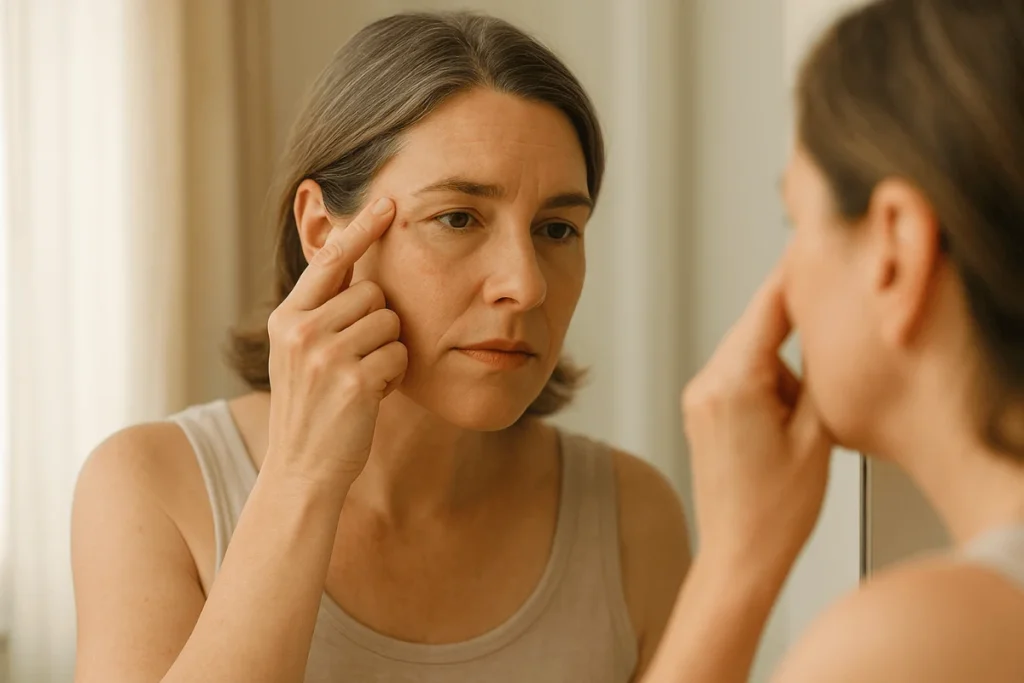
“I thought it was just a dry patch,” one of my patients told me. “A little rough spot on my temple. But months later, it still hadn’t healed — that’s when I knew I should get it checked.”
If you’ve wondered about the early signs of squamous cell carcinoma, you’re not alone. Squamous cell carcinoma (SCC) is the second most common skin cancer, and early on it can look like everyday skin issues — a scab, a rough patch, or a bump that keeps coming back. The upside: when found early, SCC is highly treatable with straightforward procedures.
My goal is to help you recognize the subtle clues early, so you can act with confidence rather than worry.
For a broader view of preventive health, explore our Complete Guide to Preventive Health.
Table of Contents
What Is Squamous Cell Carcinoma?
SCC begins in the squamous cells near the skin’s surface — the “brick wall” that shields your body. Over time, UV radiation from sunlight or tanning beds damages that wall. At first, you may feel a little roughness; with continued damage, abnormal cells can grow and eventually form cancer.
It’s most common in adults over 40 and in people with fair skin, but I diagnose SCC in younger patients too, especially those with years of sun or tanning bed exposure.
Common locations:
- Face, ears, lips, and nose
- Neck and chest
- Backs of the hands and forearms
- Scalp (particularly with thinning hair)
Early signs of squamous cell carcinoma are often dismissed as minor skin problems. The key difference is persistence — they don’t truly heal.
What Do Early Signs of Squamous Cell Carcinoma Look Like?
Below are nine patterns I see often in clinic. If any of these sound familiar and last 12 weeks or more, get them checked.
1) The non-healing sore
- A scab or sore that bleeds, partly heals, then reopens — cycling for 3 months or more.
- Unlike a pimple: it never fully clears and may crust repeatedly.
2) The rough, scaly patch
- Feels like sandpaper; often pink or red.
- Unlike eczema: moisturizers and OTC steroid creams don’t resolve it.
3) The wart-like growth
- A firm, raised bump with a rough or cauliflower-like surface.
- Unlike a typical wart: it can grow faster and easily bleed if nicked.
4) The red, elevated nodule
- Shiny or scaly, sometimes tender to the touch.
- Unlike an age spot: thicker, with texture — occasionally forming a tiny “horn.”
5) The cutaneous horn
- A hard, cone-shaped stack of keratin.
- Not all horns are cancer, but a portion hide SCC at the base.
6) A changing lip (actinic cheilitis)
- Persistent dryness, cracking, or a scaly patch on the lower lip.
- Feels rough, may sting with spicy foods; can evolve into SCC.
7) A crusted ear or scalp spot
- A scaly, sore patch on the ear rim or balding scalp.
- These areas get intense sun and are common SCC sites.
8) A new bump on a scar or chronic wound
- SCC can arise in old burns, scars, or non-healing ulcers.
- Any growth emerging from a longstanding wound needs evaluation.
9) Numbness, tenderness, or tingling in a stubborn spot
- Nerve irritation can occur in deeper or more aggressive lesions.
- Unusual sensations alongside a persistent lesion are a red flag.
Dr. Chou’s tip: Use the “3‑month rule.” If a spot hasn’t truly healed in 12 weeks, it deserves a professional look. Hearing “it’s nothing” is a relief; waiting too long is the real risk.
Quick Comparison: Common Mimics vs. SCC
| Lesion Type | How It Looks/Feels | Common Mimic | Key Difference |
|---|---|---|---|
| Non-healing sore | Bleeds, scabs, reopens | Pimple or cut | Pimple heals within weeks; SCC persists >12 weeks |
| Rough, scaly patch | Sandpaper texture | Eczema | Moisturizers fail; patch keeps returning |
| Wart-like bump | Firm, rough, may bleed | Common wart | Faster growth, more fragile surface |
| Red nodule | Raised, shiny or scaly | Age spot | Thicker with texture; may be tender |
Who’s at Higher Risk?
Anyone can develop SCC, but risk rises with cumulative UV exposure. You’re at higher risk if you have:
- Fair skin, freckles, or you burn easily
- Age 50+ (more years in the sun = more damage)
- History of blistering sunburns (even one in childhood)
- Chronic sun exposure (outdoor work, sports, gardening)
- A weakened immune system (transplant recipients, long-term immunosuppressants)
- Certain HPV strains (linked to SCC in skin and mucous membranes)
Myth-buster: Skin cancer isn’t just an “older person’s” disease. I’m diagnosing more SCC in patients under 50, often tied to tanning beds or years of unprotected sun.
How to Check Your Skin (Without Panic)
You don’t need medical training to spot the early signs of squamous cell carcinoma. Aim for a calm, regular routine — like checking your car’s oil.
My simple “ABCDE” with an SCC twist:
- A — Area: Prioritize sun-exposed zones (face, scalp, ears, backs of hands).
- B — Bleeding: Open spots that ooze or bleed without obvious injury.
- C — Change: Any shift in size, shape, color, or texture.
- D — Diameter: Small spots count if they’re new, changing, or persistent.
- E — Elevated/Evolving: Raised patches or nodules that keep changing or won’t heal.
Self-check tips:
- Use bright natural light and a hand mirror; part hair to see the scalp
- Look at ears (front and back), lips, nose, neck, hands, forearms, shins, and tops of feet
- Ask a partner to check hard-to-see spots
- Photograph suspicious areas monthly to track changes
Yes, SCC can appear under nails or inside the mouth (less common). If a sore, growth, or discoloration persists in these areas, get it checked promptly.
When to See a Dermatologist
Call sooner rather than later if you notice:
- A sore or patch that hasn’t healed in 3 months
- A spot that bleeds easily or keeps recurring
- A rapidly growing, firm, or scaly lump
- Persistent tenderness, itching, or tingling in one area
What to expect at the visit:
- A focused skin exam, often with a dermatoscope (a magnifying light)
- If concerning, a small, quick skin biopsy — the definitive way to diagnose SCC
- If it’s caught early, treatment is typically simple and highly effective
For patient-friendly guidance on skin cancer warning signs, the Skin Cancer Foundation is a reliable resource: https://www.skincancer.org/skin-cancer-information/squamous-cell-carcinoma/
Treatment Options and What to Expect
Treatment depends on the size, depth, and location of the cancer, along with your health status. Most early SCCs are handled in the office.
- Cryotherapy (freezing): Often used for very superficial lesions
- Electrodessication and curettage (ED&C): Scraping and cauterizing small, low-risk cancers
- Topical medicines (for SCC in situ): Prescription creams like 5‑FU or imiquimod
- Photodynamic therapy (selected superficial cases)
- Excision: Surgically removing the lesion with a safety margin
- Mohs micrographic surgery: A stage-by-stage technique for high-risk or cosmetically sensitive areas (face, ears, lips, scalp), offering the highest cure rates while sparing healthy tissue
- Radiation therapy: For those who cannot undergo surgery
Cure rates for early SCC are excellent; Mohs surgery can achieve 97–99% for many primary lesions. Your dermatologist will discuss the best option for your specific case.
Prevention That Actually Works
Even if you recognize the early signs of squamous cell carcinoma once, your best strategy is to prevent the next one.
- Choose a broad-spectrum sunscreen SPF 30+ and reapply every 2 hours outdoors (and after swimming/sweating)
- Wear a wide-brimmed hat, UV-blocking sunglasses, and sun-protective clothing
- Seek shade between 10 a.m. and 4 p.m.; check the UV Index before heading out
- Avoid tanning beds — they significantly boost SCC risk
- Perform monthly self-checks; schedule routine skin exams if you’ve had skin cancer or precancers (actinic keratoses)
- Ask your doctor if you’re a candidate for additional preventive strategies (for example, some high‑risk patients may benefit from nicotinamide, a form of vitamin B3)
Small, consistent steps here are highly effective and pay off for decades.
Summary and Action Checklist
Early signs of squamous cell carcinoma are easy to miss — and easy to manage when found early. Here’s a practical checklist:
- Use the 3‑month rule: any spot that won’t heal after 12 weeks should be examined
- Watch for non-healing sores, rough scaly patches, wart‑like bumps, and tender nodules
- Prioritize sun-exposed areas in your self-checks
- Book promptly if you notice bleeding, rapid growth, or unusual sensations
- Protect your skin daily: sunscreen, shade, and protective clothing
Your skin protects you every day. Give it that same care in return. A brief exam today can spare you a bigger procedure tomorrow — and that peace of mind is priceless.
For deeper background and expert guidance, you can also review the American Cancer Society overview of skin cancers: https://www.cancer.org/cancer/skin-cancer.html
And tomorrow? Put on that sunscreen.